

Prediction of chromatographic behaviors
Predict the expected Retardation Factor (Rf) of any organic compound, simulate the Thin-Layer Chromatography (TLC) of any mixture and screen for the best eluents to purify your target compounds.
Predict the expected TLC
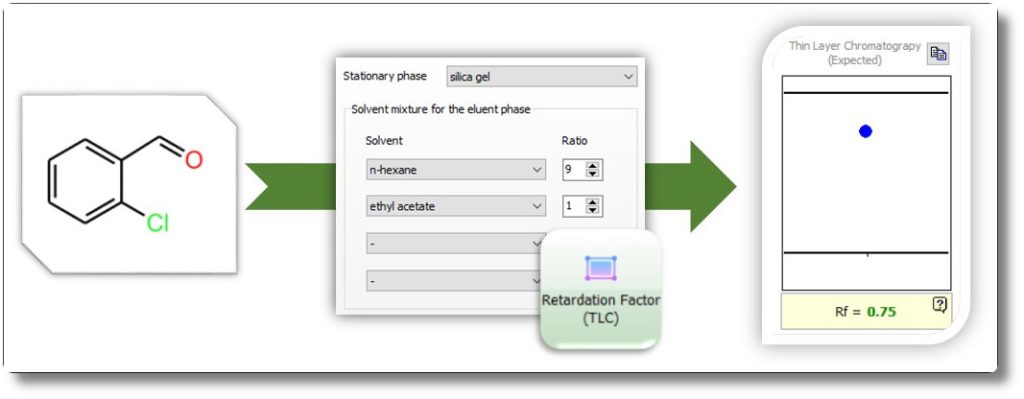
As Thin-Layer Chromatography (TLC) is one of the most used techniques to monitor de step of chemical reactions and infer whether a particular compound is present in a mixture or not, its prediction can become an extremely powerful tool when tackling new projects.
The Retardation Factor (Rf) can be predicted by indicating which stationary phase (chromatography plates) and eluent phase (solvent mixture) should be employed.
Screen for the most convenient chromatographic eluent
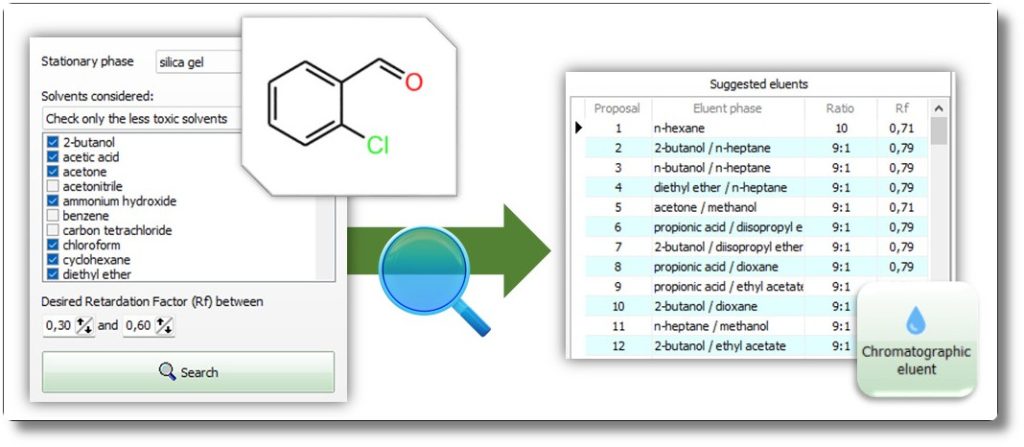
Finding the eluent to perform a Thin-Layer Chromatography (TLC) becomes an easy task by letting the software look for the best solvent combinations.
Simply draw a molecule, indicate a stationary phase and specify which Retardation Factor (Rf) range would you find it suitable.
Simulate the TLC of a mixture of compounds
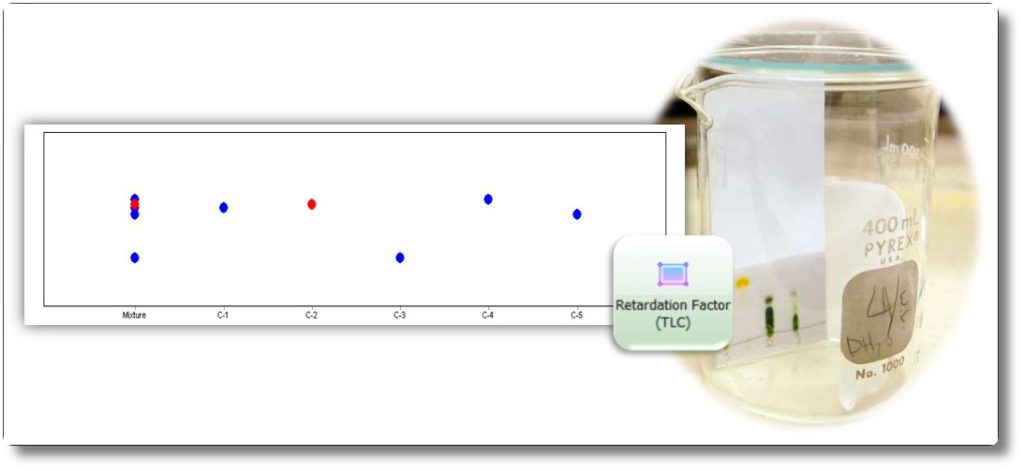
Infer the approximate aspect that the Thin-Layer Chromatography (TLC) will have for a particular mixture of compounds.
- Predict the Retardation Factors (Rf) of your compounds and see how the TLC of your reaction will probably look like.
- Know in advance whether the stains of your compounds are likely to appear overlapped or not.
- See how TLC changes when using different eluent and stationary phases.
Screen for the best chromatographic eluent to purify a compound
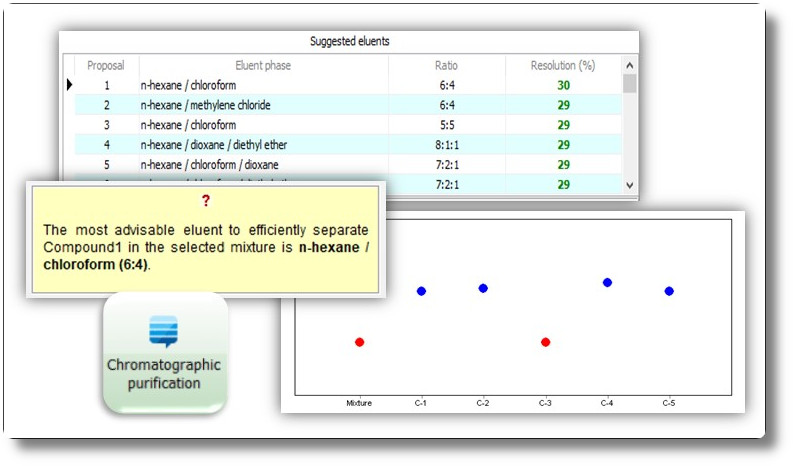
If you are planning to purify a compound by using chromatographic techniques, a suitable solvents mixture for the eluent phase must be determined.
Instead of directly tying it in the lab, simply let ORCOD give you several proposals to start with.
- Avoid wasting solvents, time and efforts unnecessarily.
- Select whether you wish to search by using all the available solvents, only the less toxic or only the most common ones.
- Rate the proposals in terms of resolution (%) to separate your target compound from the rest.
- Try different stationary phases.